
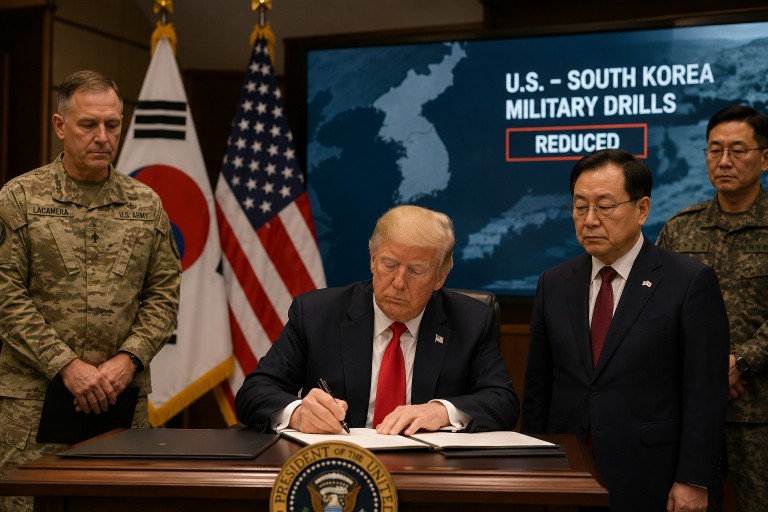
President Donald Trump has announced a significant reduction in joint military exercises with South Korea, citing high costs and the potential for sending the wrong message to North Korea. This decision is linked to what Trump describes as his “very good relationship” with North Korean leader Kim Jong-un. The Ulchi Freedom Shield exercises, set to run from Monday until August 27, involve around 18,000 South Korean troops, along with U.S. forces and personnel from several United Nations Command member states. While Trump has directed Defense Secretary Pete Hegseth to reduce U.S. participation, the South Korean defense ministry has stated that the drills will proceed as originally planned.
Military experts from the U.S. and South Korea have expressed concerns about North Korea’s growing military capabilities, enhanced by its cooperation with Russia in the Ukraine conflict. North Korea has sent over 14,000 troops to support Russian forces and has supplied artillery ammunition and ballistic missiles. This collaboration is reportedly providing North Korean forces with experience in modern warfare technologies, such as drones, GPS disruption, cyber operations, and missile systems. U.S. military officials have adapted the exercises to address these evolving threats, warning that the skills North Korean troops are acquiring could bolster Pyongyang’s military strength upon their return.
The decision to scale back the drills is not without precedent. Trump has previously reduced or suspended major military exercises with South Korea in efforts to engage diplomatically with Kim. However, this latest move has sparked concerns in Seoul regarding the future of the U.S.-South Korea alliance and the effectiveness of regional deterrence strategies. South Korean experts argue that cutting back on these exercises could weaken military readiness and deterrence, while offering limited diplomatic gains, as North Korea has consistently demanded their complete cessation.
North Korea has consistently denounced these military exercises, labeling them as a rehearsal for an offensive war and has threatened to respond with heightened military actions. Ahead of the scheduled drills, Pyongyang has test-fired ballistic missiles, escalating tensions further. Despite Trump’s directive, South Korean officials maintain that the joint exercises are crucial for preparing against a North Korean military that is becoming increasingly capable.